Wednesday, February 21, 2018

Question: What do you eat for Breakfast?

Finding good food to eat is one of the hardest challenges of B6 toxicity, so I want to ask all of you: What do you eat for breakfast?

Personally, I eat oatmeal every day.

Oatmeal with
▪ Raisins (or blueberries or stewed apples) 
▪ Flaxseed (about 1 teaspoon) 
▪ Pumpkin seeds (1-2 tablespoons) 
▪ Pecans
▪ Soymilk (or milk)

It might not sound like much, but I haven't gotten bored of it after more than a year. On occasion, I have used peaches, strawberries, or mixed berries instead of raisins. On rare occasions (when I have a sweet-tooth), I will add a bit of jam or honey. 

If you've found a good low-B6 breakfast, please leave a comment below and let everyone know what it is!  If enough people answer, then eventually we should have a long list of meal ideas.

Wednesday, September 6, 2017

Finding foods that are low in B6

Hello, all. A commenter wanted me to make a list of foods that are relatively low in B6. That might take a while, so for now I want to give everyone a tip on how to find low-B6 foods. Google makes this very easy to do: Just search "b6 in food," where food is the specific food that you are searching for. For example, here is the result for "b6 in potato."


As you can see, one medium potato has 0.6 mg in it (according to the USDA). You can change the Type and Quantity to get the results for different sizes and kinds of potatoes.

The highest foods -- corn, potatoes, bananas, etc. -- tend to have 0.4mg or more B6 in one serving. So if you see a food that has 0.4mg or more, then you probably want to avoid it. Instead, look for foods that have 0.2mg or less. Just make sure that you are paying attention to the quantity. For example, 0.7mg is a lot of B6, but what if it's 0.7mg in a gallon? If you are only eating a few tablespoons, then you are only eating a small fraction of that 0.7mg. So always pay attention to quantity when searching.

Hope that helps!

Tuesday, August 15, 2017

Day 670+: Quick Update

Hi, folks! I hope you are all doing well. I haven't posted in a long time because my B6 toxicity symptoms have gradually lessened. I have been able to incorporate more and more foods back into my diet to the point where B6 toxicity plays only a small role in my life (I should note that I've essentially been vegetarian since my symptoms started, since meat is so high in B6. That might be a bigger struggle for some people than others).

My recent meals have included chili and a medium-sized baked potato, avocado and tomato sandwiches, and even a few french fries here and there. I could not have eaten those things 670 days ago.

The last time I had noticeable B6 toxicity symptoms was over the holidays (baked ham) and about two months ago, when I ate a a lot of candies that contained walnuts. The recurrence in December was pretty bad, but the more recent one was over within a few hours.

For the most part, I feel like my life is back to normal. There's still some lingering nerve damage, but not enough to cause concern. I feel good.

Before I sign off (probably for another few months, at least), I want to share a few habits that have helped me in my own recovery:

(1) Drink water with every meal. Drinking water is always important, but it's most important when you are digesting food. If you drink water when you eat, then the B6 has a higher chance of passing from your body; otherwise your body absorbs the B6 like any other nutrient. I always drink a full glass of water with my meals, and if I eat something unusually high in B6 (like potato or avocado), then I continue to drink for another 30 minutes after eating.

(2) If I start to feel burning, twinging, or spasms in my muscles after eating B6, then I exercise those muscles immediately! I don't know why this seems to help for me, but it does. Recently, when my arms started to twinge after eating those walnut candies, I hit the weights. The symptoms went away almost immediately.

That's it. Those are the only things I've found that help -- besides time and patience, of course.

Good luck on your recovery!

Wednesday, October 26, 2016

Day 365+: One Year

Exactly one year ago today (October 26, 2015), I made my first blog post. One year ago, I came down with B6 toxicity.

Since then, I've experienced some recovery. My symptoms are no longer as bad as they were. The slight neuropathy in my arms is intermittent and easy to ignore. The neurological problems have mostly gone away, although I still feel that my balance isn't as good as it used to be. Still, I feel pretty good.

Looking back, I would say that the first month was the hardest. The symptoms were all but debilitating. Even after the neuropathy began to fade, I still struggled with adjusting to a new diet. And there was the anxiety, which was almost as bad as the neuropathy. Some of it was caused by the toxicity, but some of it was just a natural result of being sick. It's not easy wrestling with the thought that you might never be well again.

After that, things got better. In fact, the past six months have been pretty uneventful. I still watch my diet, and I still pay the price when I fall off the wagon, but the consequences are less severe. A few weeks ago, for example, I ate a high-B6 meal and my arms burned all night, but I was surprised to feel no lingering effects the next morning. When I woke up, my arms felt fine. I took that as a sign of healing. It's as though my body is getting better at handling B6 and getting over high dosages when I make the mistake of eating them.

Speaking of food, I've added a few medium-high B6 foods back into my diet, and I no longer worry about over-indulging on tomatoes or broccoli. They don't seem to affect me. However, I won't touch potatoes, bananas, corn, or brown rice. They're just too high in B6. Maybe after the two-year mark, I'll start re-incorporating them. For now, I'm content with what I have to eat.

Anyways, I just wanted to update everyone on my condition. I know some people follow this blog and use it to gauge their own recovery. If I were to sum up my current situation in one sentence, it would be: I've come a long way, but there's still a long way to go.

I think I have at least another year of recovery ahead of me. We'll just have to wait and see.

Friday, June 24, 2016

Day 200+: Still At It

Wow, over 3 months since my last update! Sorry about that. But as I said in my last post, B6 toxicity has taken a backseat in my life, so I'm not inclined to write about it every day or every week. Which is good, in my opinion, because it means that I'm back in control of my life.

So what's new?

The answer is: Nothing.  I still have B6 toxicity, my elbows still tingle, and I still can't eat high-B6 foods. I have to closely monitor my diet, which is highly restrictive, and I still have dizzy spells. On the plus side, I've found several good meals that keep me from feeling deprived. For the most part, I'm doing well.

That said, I've had a few "relapses" over the past few months. Most were fairly small, taking the form of gentle reminders from my body that B6 is not too good for me. Once, for example, after eating guacamole several meals in a row, I had neuropathy in my hands. That's fine. I can live with that. But some of the relapses have been bad. The worst was last week, when I finally broke down, threw caution to the wind, and ate at a restaurant. That was a mistake. Within a few hours, all the old symptoms had returned: muscle spasms, pain, tingling, etc. It was bad enough to keep me up at night (with anxiety, if not pain). I didn't know when, or if, I would get better. But I'm glad to say that the symptoms have mostly passed, and I'm starting to get back to "normal."


So what's the take-away? I would say that recovery is slow. I don't expect healing in less than a year, maybe two years. I got B6 toxicity in October 2015, so I can expect a full recovery by October 2016 at the earliest. October 2017 sounds a lot more likely -- assuming I stick to my diet and don't fall off the wagon too many more times. It might be October 2018. That wouldn't surprise me.

Either way, I think I can do it.

I'll leave you with this handy tidbit. It's the website I use to track B6 content in foods: the official USDA website, which I've found it to be very reliable: https://ndb.nal.usda.gov/ndb/search/list

Good luck!

Wednesday, March 2, 2016

Day 100+: No News is Good News

It's over 100 days since my toxicity began, and B6 toxicity has now taken a backseat in my life. That's a good thing, because it means that my symptoms are either fading or becoming more manageable.

For the most part, I don't experience neuropathy these days. If I spend a lot of time reading in bed, I will feel it in my elbows (because the bedsheets seems to irritate them), but other than that, the burning is a thing of the past.

I do still experience minor neurological symptoms, but they come and go. And they might not even be caused by the B6 -- they could be caused by vitamin deficiencies. That's why I've been increasing my intake of potassium (coconut water) and magnesium (pumpkin seeds), among other things.

So... am I fully recovered? No. If the neurological symptoms are caused by B6, then I still have some healing to do. And there's still the occasional neuropathy in my elbows. And I still haven't begun incorporating B6 foods back into my diet (and frankly, I'm afraid to). But for the most part, B6 toxicity isn't a major part of my life anymore.

I will continue to update this blog, but unless there's a major development in my recovery, the posts will be infrequent.

Sunday, January 31, 2016

Day 76-99: Everyone's symptoms are different

My symptoms haven't changed much over the past few weeks. I think my previous theory was correct and my ulnar (elbow) nerves are "permanently" damaged. (I put "permanently" in scare-quotes because there's no telling what the future will bring. Maybe with enough healthy living, my body will eventually repair itself. But for the time being, the effects are unremitting.)

One thing I've discovered in researching B6 toxicity is that everyone's symptoms are a little different. Some people experience a lot of fatigue and brain-fog, while others experience a lot of neuropathy (which is probably the most typical symptom). But most people who experience neuropathy experience it in their hands and feet, whereas I experience it in my knees and elbows

Symptoms aren't the only thing to vary, either; remedies do as well. Some people feel better after exercise, while others report feeling worse (possibly because the B6 is being released from the muscles and into the blood stream).

All this just adds up to further difficulties for B6 toxicity sufferers. For the most part, we have to find what works for us.

Thursday, January 7, 2016

Preventing Vitamin Deficiencies: Taking B6 out of your diet takes out a lot of other things too

One of the struggles of dealing with B6 toxicity is avoiding vitamin deficiencies. Unfortunately, when you take B6 out of your diet, you inadvertently take out a lot of other things too. Over the past few weeks, I've had to closely monitor my diet and make adjustments in order to cover all the bases.

The biggest trouble-spots for me have been calcium, magnesium, potassium, and niacin. Thankfully, I've found good solutions for most of these. For calcium, I drink soy milk. For potassium, I eat dried apricots. And for niacin, I eat peanut butter (1-4 tablespoons a day).

Yes, these things aren't exactly low in B6, but I make sure to spread them out over the day so my body has time to flush it out.

The best way to prevent a vitamin deficiency is to monitor your nutrient intake. You can do this with several free online tools -- just do a search for diet trackers. You will have to log everything you eat, which is time-consuming, but if you have B6 toxicity, it's worth it. A few times now, I have developed the beginnings of vitamin deficiencies, and if I hadn't been expecting such a possibility, the symptoms might have progressed much further than they did. Since I started tracking my diet, I've felt much more secure and less anxious overall. Knowing I'm not vitamin deficient is one less thing to worry about.

Day 61-75: On the Mend Again

In my last post, I talked about alarming new neurological symptoms. I'm glad to say that two weeks later, those symptoms have all but gone away. I credit my improvement to rigidly following a low-B6 diet. If I don't know what the B6 content of something is, then I won't eat it. In general, I try to keep my daily B6 intake at or under 1.3mg. I also try not to exceed 0.4mg with any one meal.

So, 2-and-a-half months after first developing symptoms and stopping supplementation, how am I doing? I would say fairly well, but not cured. At this point, I'm not sure I ever will be 100% healed. What B6 toxicity does (as far as I understand it) is deteriorate the protective myelin sheath around nerves (a process called demyelination). I seem to have suffered the worst demyelination in my arms (the ulnar nerve), which leads to almost constant tingling around the elbows. Maybe my arms will heal over time (it's still fairly early -- some people take years to heal), but only time will tell.

Other than that, I don't have any noticeable symptoms (unless I fall off the wagon and eat B6, that is). That's why I say I'm doing fairly well. Considering how bad B6 toxicity symptoms CAN be, mine aren't so bad.

Wednesday, December 23, 2015

Day 40-60: Neurological Symptoms

Sorry I haven't written here in a while. A couple weeks ago, after eating some B6 foods, I began experiencing serious neurological symptoms. These symptoms are very similar to ALS and MS and are very disruptive. The only way I can describe them is to say that my head feels like a sailboat and my body is the ocean. For a while, it was difficult to walk in a straight line. Since then, I've gotten a bit better, but only by being very strict about my diet.

At this point, I need to be careful, because I can't afford to get any worse. Being bedridden would mean losing my job, and I think that's a real possibility given the experiences that other people have had. I've had two major downturns since the B6 toxicity started. The first gave me severe neuropathy in my arms (which has yet to heal), and the second gave me these neuro-motor symptoms. I don't want to find out what a third downturn will be like, but I imagine it will be horrible.

I was hoping for a speedy recovery from this, but my new hope for recovery is sometime in the next 1-2 years.

Wednesday, December 2, 2015

Day 27-39: No Change

Not much has changed over the past two weeks. I've had consistent neuropathy in my arms ever since the last time I ate a meal with a lot of B6 in it (I would guess about 1.0mg, and it was by mistake -- it's very difficult to keep track of the B6 content of foods, especially when different sources don't necessarily agree). I hope that didn't fry my nerves for good, but I guess only time will tell. It's a bit discouraging considering I'd had several symptom-free days before that and seemed to be on the mend. Now...?

P.S. I plan to post another recipe within the next few days.

Tuesday, November 24, 2015

Low-B6 Recipes: Pad Thai

Pad Thai
This is one of my all-time favorite dishes. And that's saying a lot, considering how low it is in B6. I often double the recipe so I have enough to last for several days.

Salad ingredients
  • 1 cup red cabbage, shredded
  • 1/3 cup cilantro leaves
  • 1 teaspoon fresh lime juice
  • 1/4 cup onion, thinly sliced or chopped
  • 1/2 teaspoon salt
  • 1 cup cucumber, thinly sliced
  • 1/2 cup red bell pepper, thinly sliced and diced
  • pinch of salt
 Sauce ingredients
  • 1/2 cup almond butter (harder to find than peanut butter, but much lower in B6)
  • 1/2 tablespoon fresh ginger, finely grated
  • 2 garlic cloves
  • 2 tablespoons fresh lemon juice
  • 2 tablespoons maple syrup
  • 1 tablespoon chili sauce
  • 1 tablespoon soy sauce
  • 1/4 cup water
  • pinch of salt and pepper
1. Combine the red cabbage, cilantro, and lime juice in a bowl, sprinkle with salt, and let sit for 30 minutes.
2. Meanwhile, combine all the sauce ingredients in a blender and blend until smooth, adding more water if needed.
3. Add the remaining salad ingredients to the cabbage mixture (onion, cucumber, bell pepper) and toss.
4. Serve over Asian rice noodles (sometimes called rice sticks or rice vermicelli), or over white rice. When you store the leftovers, keep the sauce and salad in separate containers.
Pad Thai recipe, low in Vitamin B6, served over rice sticks; complete meal

Monday, November 23, 2015

Low-B6 Recipes: Carrot, Raisin, and Maple Salad

Carrot, Raisin, and Maple Salad
This side-dish can be served on a bed of lettuce or by itself. The maple syrup brings out the natural sweetness of the carrots.
  • 1 cup carrots, peeled and grated
  • 1/3 cup raisins
  • 2 tablespoons maple syrup
  • a pinch of salt
1. Combine the ingredients in a bowl and toss.
2. Serve immediately, or refrigerate and serve chilled.
Carrot, raisin, and maple salad served alongside rice and asparagus -- both low in B6
Served with rice and asparagus.

Low-B6 Recipes: Green Beans and Carrots in Orange Sauce

Green Beans and Carrots in Orange Sauce
All the ingredients of this dish are very low in B6.
  • 3 cups carrots, sliced and peeled
  • 3 cups green beans, cleaned and trimmed
  • 2 tablespoons orange juice
  • 1 tablespoon fresh lemon juice
  • 1 teaspoon maple syrup
  • a pinch of salt
1. Steam carrots alone for 5 minutes.
2. Add the green beans and steam for another 5-8 minutes, or until the carrots and beans are tender.
3. While the green beans and carrots are steaming, combine the orange juice, lemon juice, salt, and maple syrup in a bowl.
4. Add the cooked carrots and beans to the bowl with the sauce. Toss to coat, and serve.
Green Beans and Carrots in Orange Sauce

Thursday, November 19, 2015

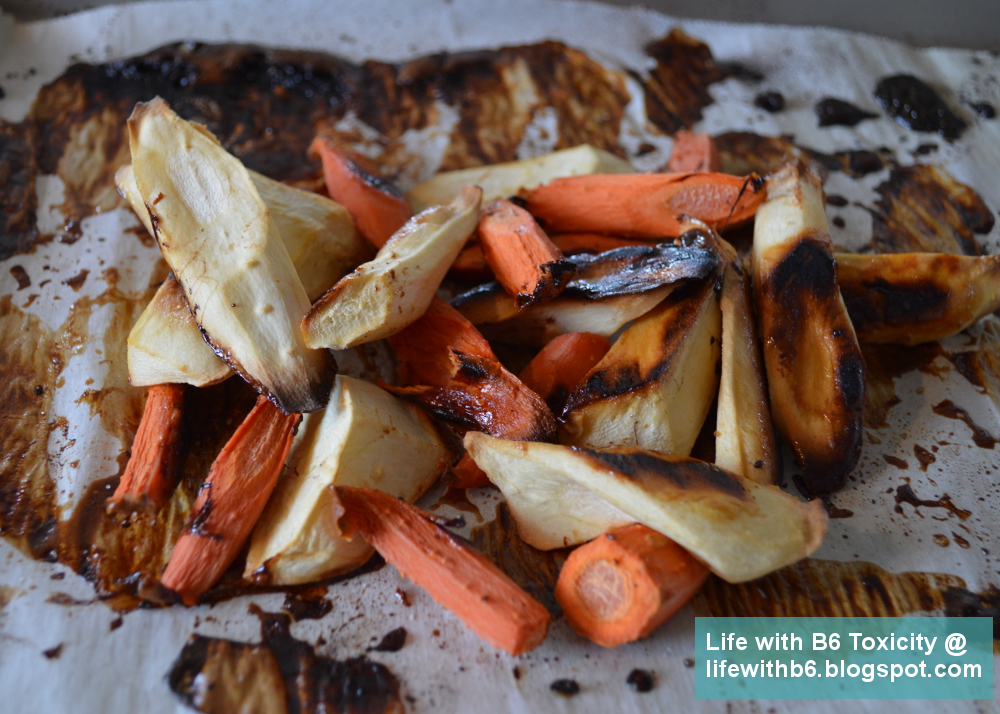
Low-B6 Recipes: Roasted Parsnip and Carrot

Roasted Parsnip and Carrot
When roasted, parsnips and carrots become sweet and tender and can be added to almost any low-B6 meal.
  • 1-3 cups fresh parsnip
  • 1-3 cups fresh carrot
  • salt and pepper
  • (optional) any desired herbs, such as thyme
  • (optional) 1-2 tablespoons maple syrup
1. Preheat oven to 400 degrees.
2. Peel the parsnips and carrots and cut them into even pieces, either chunks (for a meatier texture) or long strips (for a crunchier, french-fry-like quality). If using maple syrup, then drizzle syrup on top.
3. Line a baking sheet with parchment paper, lay the parsnip and carrot on top (as evenly spaced as possible), and sprinkle with salt, pepper, and any desired herbs.
4. Bake for about 15 minutes, then remove from oven and turn the pieces over. Bake for another 10-15 minutes.
5. When the pieces look nicely browned, remove from oven and serve either hot or warm.

roasted parsnip and carrot served with basmati rice and green beans
Roasted parsnip and carrot served with basmati rice and green beans.
roasted parsnip and carrot, tossed after leaving the oven
The roasted parsnip and carrot, tossed after leaving the oven.

Day 23-26: Ping pong

I feel like a ping pong ball, bouncing back and forth between good and poor health. Currently I'm in the poor health phase -- I ate a lot of B6 foods yesterday and paid for it. My arms feel like they survived a nuclear war -- but just a few days earlier, I had no symptoms at all, I was starting to re-incorporate foods into my diet, and I was ready to claim victory over B6 and enter "post-recovery mode." Now all that has slipped away and I feel like I'm back at square one.

So what about those periods of good health? Over the course of my toxicity, I've had several. These periods typically last a few days, and they don't necessarily occur when I do everything right. For example, I went two or three days without exercising last week due to a stomach virus, but had no toxicity symptoms during that time. So maybe exercise isn't as important to recovery as I had thought. Or maybe the effects of not exercising just take a while to build up.

All I can say for certain is that yes, diet has a huge impact on toxicity symptoms. If you want to do yourself a favor, then eat as little B6 as possible, and don't be fooled by a few symptom-free days. The tide can change with just one meal.

Wednesday, November 18, 2015

Low-B6 Recipes: Bean Soup

Bean Soup
Beans aren't necessarily low in B6 (according to the USDA, a cup of pinto beans has about 0.39mg.) But they don't seem to trigger my symptoms in the same way that other foods do, and they can be quite filling even in small servings. That's why I like to combine beans with other foods to create a complete, low-B6 meal. This simple bean soup goes well with Spanish rice, roasted vegetables, and many other foods

Update (12/23/15): I've since had reactions to pinto beans, and I no longer consider them low in B6. Black beans seem to be altogether better.
  • 3 cups dry pinto beans
  • 6 cups water
  • 1/2 cup diced onion
  • 1/2 cup diced celery
  • 1 teaspoon salt
1. Soak beans overnight in 6 cups of water.
2. Strain beans the next day and replace with enough fresh water to rise about 1 inch above the beans.
3. In a large pot, add the beans, water, onion and celery and bring to a boil.
4. Lower to simmer and cook covered for 3 hours. Make sure the temperature isn't too high or the water can boil over. (If you prefer a thicker soup, then cook the beans uncovered for part of the duration. But watch them closely so they don't boil dry and burn.)
5. Serve with chopped green onion, grapes, salsa, or anything else you think would be good. Add salt to taste.

Served with green onion and a dollop of salsa.

Sunday, November 15, 2015

Day 14-22: Steady Improvement

I have been feeling better lately. Recently, I had a few days without any symptoms at all. Because of this, I decided to start reincorporating B6 foods back into my diet in this order:
  • leafy greens and tomatoes
  • oats, maybe brown rice
  • bananas, avocados, and potatoes
  • all cereal grains
I started the first stage a few days ago, but after a day of eating pasta sauce and salad, I noticed a return of symptoms. As such, I'm going to give B6 foods a rest for a while again. But I'm not discouraged. The symptoms were less severe than they were a couple weeks ago, and they took longer to develop, so I feel that I am definitely improving.

Friday, November 6, 2015

Day 10-13

Not much has changed in the past few days. My symptoms are about where they were on Monday. I am noticing, however, that even when I'm feeling "good," things can quickly turn sour if I do the wrong things. For example, when I do a lot of manual work, my arms tend to ache or cramp (it's that hard-to-describe carpal tunnel feeling I've mentioned before). In fact, my arms get worn out pretty quickly. 40 minutes of typing feels like 3 hours. I even get worn out holding a book open at night. That's a little worrying to me.

My legs, meanwhile, have felt pretty good for several days now. I think they may have healed quicker because I do a lot of leg exercises and stretches. As a jogger, most of my workout routine is lower-body. This has been a bit of a problem, however, because while my legs are doing well, my arms, as I said, are not. I'm not sure what to do about that, as I can't lift weights every day. I guess I need to find some low-impact arm exercises. Unfortunately, nothing hits the spot the way jogging does.

Meanwhile, I ate more B6 foods today and am again feeling the effects. This time the symptoms aren't as bad (because I didn't eat as much), but it's still disappointing. You might wonder why I would eat food with B6 in it, and there are two reasons. First, eating low-B6 foods every meal has meant missing out on a lot of other vital nutrients, and I don't want to get deficient in other vitamins. Second, I like to test myself every few days to make sure I haven't gone straight from B6 toxicity to B6 deficiency, which has the same symptoms. But given how long it typically takes B6 toxicity to clear up, I think I'll wait a while before trying B6 foods again.

Tuesday, November 3, 2015

Low-B6 Recipes: Rice with Pineapple and Vegetables

Rice with Pineapple and Vegetables
White rice has less B6 than brown rice. I recommend basmati, if you can find it.
  • 1 cup white rice (preferably long-grain)
  • 1/2 cup peas
  • 1 can of pineapple chunks, with juice
  • 1/2 cup carrot, shredded
  • 1/2 cup asparagus, chopped
  • 2 tablespoons soy sauce or tamari
1. Cook rice according to the instructions.
2. While the rice is cooking, combine the vegetables, the pineapple, the pineapple juice, and the soy sauce in a skillet, and simmer until the vegetables are tender, 5-10 minutes.
3. Combine the rice with the vegetables, pineapple, and juice.
4. Add more soy sauce or tamari to taste.
The finished meal