It's over 100 days since my toxicity began, and B6 toxicity has now taken a backseat in my life. That's a good thing, because it means that my symptoms are either fading or becoming more manageable.
For the most part, I don't experience neuropathy these days. If I spend a lot of time reading in bed, I will feel it in my elbows (because the bedsheets seems to irritate them), but other than that, the burning is a thing of the past.
I do still experience minor neurological symptoms, but they come and go. And they might not even be caused by the B6 -- they could be caused by vitamin deficiencies. That's why I've been increasing my intake of potassium (coconut water) and magnesium (pumpkin seeds), among other things.
So... am I fully recovered? No. If the neurological symptoms are caused by B6, then I still have some healing to do. And there's still the occasional neuropathy in my elbows. And I still haven't begun incorporating B6 foods back into my diet (and frankly, I'm afraid to). But for the most part, B6 toxicity isn't a major part of my life anymore.
I will continue to update this blog, but unless there's a major development in my recovery, the posts will be infrequent.
Wednesday, March 2, 2016

Sunday, January 31, 2016
Day 76-99: Everyone's symptoms are different
My symptoms haven't changed much over the past few weeks. I think my previous theory was correct and my ulnar (elbow) nerves are "permanently" damaged. (I put "permanently" in scare-quotes because there's no telling what the future will bring. Maybe with enough healthy living, my body will eventually repair itself. But for the time being, the effects are unremitting.)
One thing I've discovered in researching B6 toxicity is that everyone's symptoms are a little different. Some people experience a lot of fatigue and brain-fog, while others experience a lot of neuropathy (which is probably the most typical symptom). But most people who experience neuropathy experience it in their hands and feet, whereas I experience it in my knees and elbows
Symptoms aren't the only thing to vary, either; remedies do as well. Some people feel better after exercise, while others report feeling worse (possibly because the B6 is being released from the muscles and into the blood stream).
All this just adds up to further difficulties for B6 toxicity sufferers. For the most part, we have to find what works for us.
One thing I've discovered in researching B6 toxicity is that everyone's symptoms are a little different. Some people experience a lot of fatigue and brain-fog, while others experience a lot of neuropathy (which is probably the most typical symptom). But most people who experience neuropathy experience it in their hands and feet, whereas I experience it in my knees and elbows
Symptoms aren't the only thing to vary, either; remedies do as well. Some people feel better after exercise, while others report feeling worse (possibly because the B6 is being released from the muscles and into the blood stream).
All this just adds up to further difficulties for B6 toxicity sufferers. For the most part, we have to find what works for us.
Thursday, January 7, 2016
Preventing Vitamin Deficiencies: Taking B6 out of your diet takes out a lot of other things too
One of the struggles of dealing with B6 toxicity is
avoiding vitamin deficiencies. Unfortunately, when you take B6 out of your diet, you inadvertently take out a lot of other things too. Over the past few weeks, I've had to
closely monitor my diet and make adjustments in
order to cover all the bases.
The biggest trouble-spots for me have been calcium, magnesium, potassium, and niacin. Thankfully, I've found good solutions for most of these. For calcium, I drink soy milk. For potassium, I eat dried apricots. And for niacin, I eat peanut butter (1-4 tablespoons a day).
Yes, these things aren't exactly low in B6, but I make sure to spread them out over the day so my body has time to flush it out.
The best way to prevent a vitamin deficiency is to monitor your nutrient intake. You can do this with several free online tools -- just do a search for diet trackers. You will have to log everything you eat, which is time-consuming, but if you have B6 toxicity, it's worth it. A few times now, I have developed the beginnings of vitamin deficiencies, and if I hadn't been expecting such a possibility, the symptoms might have progressed much further than they did. Since I started tracking my diet, I've felt much more secure and less anxious overall. Knowing I'm not vitamin deficient is one less thing to worry about.
The biggest trouble-spots for me have been calcium, magnesium, potassium, and niacin. Thankfully, I've found good solutions for most of these. For calcium, I drink soy milk. For potassium, I eat dried apricots. And for niacin, I eat peanut butter (1-4 tablespoons a day).
Yes, these things aren't exactly low in B6, but I make sure to spread them out over the day so my body has time to flush it out.
The best way to prevent a vitamin deficiency is to monitor your nutrient intake. You can do this with several free online tools -- just do a search for diet trackers. You will have to log everything you eat, which is time-consuming, but if you have B6 toxicity, it's worth it. A few times now, I have developed the beginnings of vitamin deficiencies, and if I hadn't been expecting such a possibility, the symptoms might have progressed much further than they did. Since I started tracking my diet, I've felt much more secure and less anxious overall. Knowing I'm not vitamin deficient is one less thing to worry about.
Day 61-75: On the Mend Again
In my last post, I talked about alarming new neurological symptoms. I'm glad to say that two weeks later, those symptoms have all but gone away. I credit my improvement to rigidly following a low-B6 diet. If I don't know what the B6 content of something is, then I won't eat it. In general, I try to keep my daily B6 intake at or under 1.3mg. I also try not to exceed 0.4mg with any one meal.
So, 2-and-a-half months after first developing symptoms and stopping supplementation, how am I doing? I would say fairly well, but not cured. At this point, I'm not sure I ever will be 100% healed. What B6 toxicity does (as far as I understand it) is deteriorate the protective myelin sheath around nerves (a process called demyelination). I seem to have suffered the worst demyelination in my arms (the ulnar nerve), which leads to almost constant tingling around the elbows. Maybe my arms will heal over time (it's still fairly early -- some people take years to heal), but only time will tell.
Other than that, I don't have any noticeable symptoms (unless I fall off the wagon and eat B6, that is). That's why I say I'm doing fairly well. Considering how bad B6 toxicity symptoms CAN be, mine aren't so bad.
So, 2-and-a-half months after first developing symptoms and stopping supplementation, how am I doing? I would say fairly well, but not cured. At this point, I'm not sure I ever will be 100% healed. What B6 toxicity does (as far as I understand it) is deteriorate the protective myelin sheath around nerves (a process called demyelination). I seem to have suffered the worst demyelination in my arms (the ulnar nerve), which leads to almost constant tingling around the elbows. Maybe my arms will heal over time (it's still fairly early -- some people take years to heal), but only time will tell.
Other than that, I don't have any noticeable symptoms (unless I fall off the wagon and eat B6, that is). That's why I say I'm doing fairly well. Considering how bad B6 toxicity symptoms CAN be, mine aren't so bad.
Wednesday, December 23, 2015
Day 40-60: Neurological Symptoms
Sorry I haven't written here in a while. A couple weeks ago, after eating some B6 foods, I began experiencing serious neurological symptoms. These symptoms are very similar to ALS and MS and are very disruptive. The only way I can describe them is to say that my head feels like a sailboat and my body is the ocean. For a while, it was difficult to walk in a straight line. Since then, I've gotten a bit better, but only by being very strict about my diet.
At this point, I need to be careful, because I can't afford to get any worse. Being bedridden would mean losing my job, and I think that's a real possibility given the experiences that other people have had. I've had two major downturns since the B6 toxicity started. The first gave me severe neuropathy in my arms (which has yet to heal), and the second gave me these neuro-motor symptoms. I don't want to find out what a third downturn will be like, but I imagine it will be horrible.
I was hoping for a speedy recovery from this, but my new hope for recovery is sometime in the next 1-2 years.
At this point, I need to be careful, because I can't afford to get any worse. Being bedridden would mean losing my job, and I think that's a real possibility given the experiences that other people have had. I've had two major downturns since the B6 toxicity started. The first gave me severe neuropathy in my arms (which has yet to heal), and the second gave me these neuro-motor symptoms. I don't want to find out what a third downturn will be like, but I imagine it will be horrible.
I was hoping for a speedy recovery from this, but my new hope for recovery is sometime in the next 1-2 years.
Wednesday, December 2, 2015
Day 27-39: No Change
Not much has changed over the past two weeks. I've had consistent neuropathy in my arms ever since the last time I ate a meal with a lot of B6 in it (I would guess about 1.0mg, and it was by mistake -- it's very difficult to keep track of the B6 content of foods, especially when different sources don't necessarily agree). I hope that didn't fry my nerves for good, but I guess only time will tell. It's a bit discouraging considering I'd had several symptom-free days before that and seemed to be on the mend. Now...?
P.S. I plan to post another recipe within the next few days.
P.S. I plan to post another recipe within the next few days.
Tuesday, November 24, 2015
Low-B6 Recipes: Pad Thai
Pad Thai
This is one of my all-time favorite dishes. And that's saying a lot, considering how low it is in B6. I often double the recipe so I have enough to last for several days.
Salad ingredients
2. Meanwhile, combine all the sauce ingredients in a blender and blend until smooth, adding more water if needed.
3. Add the remaining salad ingredients to the cabbage mixture (onion, cucumber, bell pepper) and toss.
4. Serve over Asian rice noodles (sometimes called rice sticks or rice vermicelli), or over white rice. When you store the leftovers, keep the sauce and salad in separate containers.

This is one of my all-time favorite dishes. And that's saying a lot, considering how low it is in B6. I often double the recipe so I have enough to last for several days.
Salad ingredients
- 1 cup red cabbage, shredded
- 1/3 cup cilantro leaves
- 1 teaspoon fresh lime juice
- 1/4 cup onion, thinly sliced or chopped
- 1/2 teaspoon salt
- 1 cup cucumber, thinly sliced
- 1/2 cup red bell pepper, thinly sliced and diced
- pinch of salt
- 1/2 cup almond butter (harder to find than peanut butter, but much lower in B6)
- 1/2 tablespoon fresh ginger, finely grated
- 2 garlic cloves
- 2 tablespoons fresh lemon juice
- 2 tablespoons maple syrup
- 1 tablespoon chili sauce
- 1 tablespoon soy sauce
- 1/4 cup water
- pinch of salt and pepper
2. Meanwhile, combine all the sauce ingredients in a blender and blend until smooth, adding more water if needed.
3. Add the remaining salad ingredients to the cabbage mixture (onion, cucumber, bell pepper) and toss.
4. Serve over Asian rice noodles (sometimes called rice sticks or rice vermicelli), or over white rice. When you store the leftovers, keep the sauce and salad in separate containers.

Monday, November 23, 2015
Low-B6 Recipes: Carrot, Raisin, and Maple Salad
Carrot, Raisin, and Maple Salad
This side-dish can be served on a bed of lettuce or by itself. The maple syrup brings out the natural sweetness of the carrots.
2. Serve immediately, or refrigerate and serve chilled.
This side-dish can be served on a bed of lettuce or by itself. The maple syrup brings out the natural sweetness of the carrots.
- 1 cup carrots, peeled and grated
- 1/3 cup raisins
- 2 tablespoons maple syrup
- a pinch of salt
2. Serve immediately, or refrigerate and serve chilled.
 |
| Served with rice and asparagus. |
Low-B6 Recipes: Green Beans and Carrots in Orange Sauce
Green Beans and Carrots in Orange Sauce
All the ingredients of this dish are very low in B6.
2. Add the green beans and steam for another 5-8 minutes, or until the carrots and beans are tender.
3. While the green beans and carrots are steaming, combine the orange juice, lemon juice, salt, and maple syrup in a bowl.
4. Add the cooked carrots and beans to the bowl with the sauce. Toss to coat, and serve.
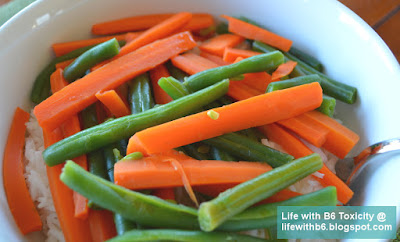
All the ingredients of this dish are very low in B6.
- 3 cups carrots, sliced and peeled
- 3 cups green beans, cleaned and trimmed
- 2 tablespoons orange juice
- 1 tablespoon fresh lemon juice
- 1 teaspoon maple syrup
- a pinch of salt
2. Add the green beans and steam for another 5-8 minutes, or until the carrots and beans are tender.
3. While the green beans and carrots are steaming, combine the orange juice, lemon juice, salt, and maple syrup in a bowl.
4. Add the cooked carrots and beans to the bowl with the sauce. Toss to coat, and serve.

Thursday, November 19, 2015
Low-B6 Recipes: Roasted Parsnip and Carrot
Roasted Parsnip and Carrot
When roasted, parsnips and carrots become sweet and tender and can be added to almost any low-B6 meal.
2. Peel the parsnips and carrots and cut them into even pieces, either chunks (for a meatier texture) or long strips (for a crunchier, french-fry-like quality). If using maple syrup, then drizzle syrup on top.
3. Line a baking sheet with parchment paper, lay the parsnip and carrot on top (as evenly spaced as possible), and sprinkle with salt, pepper, and any desired herbs.
4. Bake for about 15 minutes, then remove from oven and turn the pieces over. Bake for another 10-15 minutes.
5. When the pieces look nicely browned, remove from oven and serve either hot or warm.
When roasted, parsnips and carrots become sweet and tender and can be added to almost any low-B6 meal.
- 1-3 cups fresh parsnip
- 1-3 cups fresh carrot
- salt and pepper
- (optional) any desired herbs, such as thyme
- (optional) 1-2 tablespoons maple syrup
2. Peel the parsnips and carrots and cut them into even pieces, either chunks (for a meatier texture) or long strips (for a crunchier, french-fry-like quality). If using maple syrup, then drizzle syrup on top.
3. Line a baking sheet with parchment paper, lay the parsnip and carrot on top (as evenly spaced as possible), and sprinkle with salt, pepper, and any desired herbs.
4. Bake for about 15 minutes, then remove from oven and turn the pieces over. Bake for another 10-15 minutes.
5. When the pieces look nicely browned, remove from oven and serve either hot or warm.
 |
| Roasted parsnip and carrot served with basmati rice and green beans. |
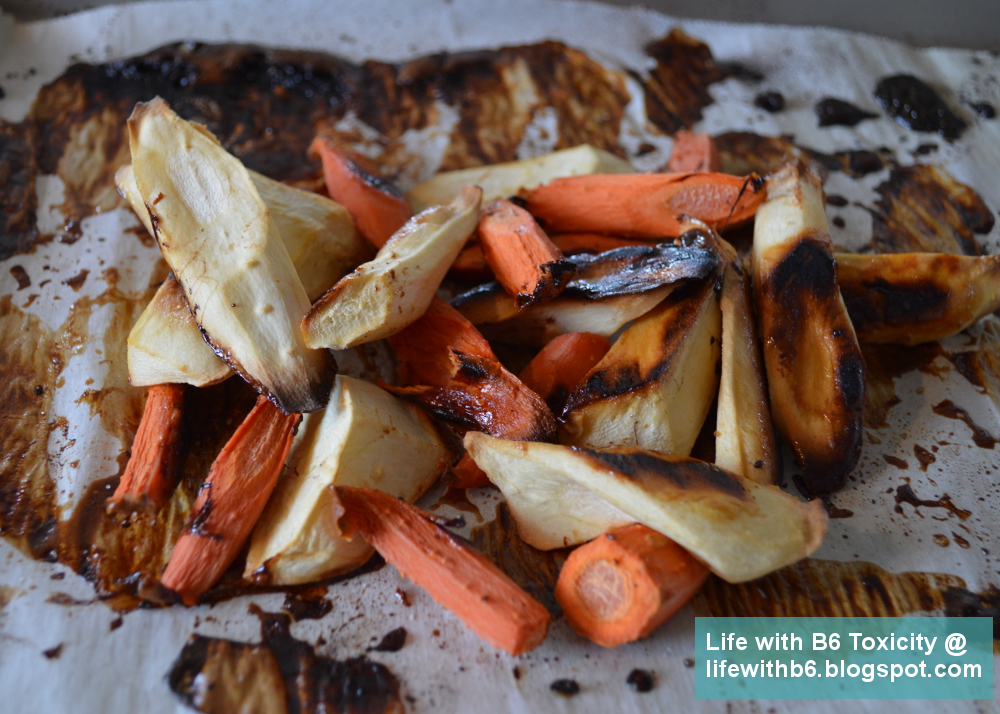 |
| The roasted parsnip and carrot, tossed after leaving the oven. |
Subscribe to:
Posts (Atom)